Why we need to stop tailoring lessons to VARK preferences (aka. learning styles), and start aligning them to content instead.
The Myth That Won’t Die
Imagine a science instructor presenting a lesson on the phases of the moon. One student receives a lyrical song about lunar cycles, another gets a detailed text handout, and a third is handed a ball and flashlight to act it out. Why? Because the students “prefer” auditory, reading/writing, or kinesthetic learning styles.
Sounds learner-centered, right?
Unfortunately, this practice is grounded in one of education’s most persistent and damaging myths: the learning styles theory, the belief that instruction is most effective when delivered in a student’s preferred sensory modality (visual, auditory, reading/writing, or kinesthetic, often abbreviated as VARK).
Despite its popularity in teacher training programs, professional development workshops, and even curriculum planning, this myth has been thoroughly debunked by decades of cognitive science. And yet, it lingers, misguiding teachers, miseducating students, and misdirecting valuable instructional time.
Let’s unpack why it’s time to lay this myth to rest—and what we should do instead.
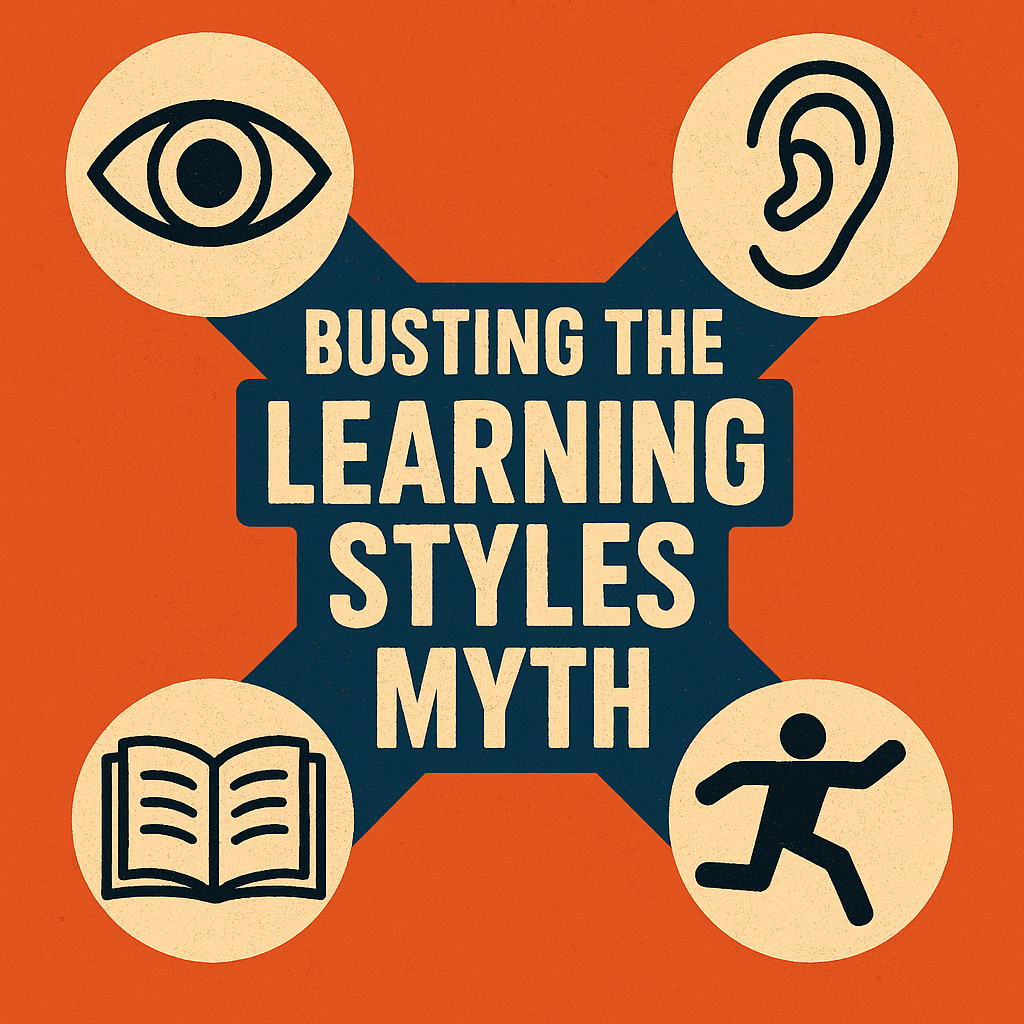
Graphic created using Chat GPT
Where the Learning Styles Myth Falls Apart
The appeal of learning styles is intuitive. It suggests a personalized, differentiated approach to instruction, something educators strive for. But here’s the catch: there’s no credible scientific evidence that matching instruction to a learner’s preferred style improves outcomes.
Pashler et al. (2008), in a seminal review, concluded there is no support for the “meshing hypothesis.” In other words, people don’t learn better when taught in their preferred style. Rather, people tend to believe they do, and so do their teachers.
This belief becomes self-reinforcing. Students told they’re “visual learners” begin to avoid texts, even when reading comprehension is essential. Auditory “learners” shy away from diagrams or visuals. Educators, in turn, feel pressured to create four different versions of the same lesson, not for pedagogical value but to tick off the VARK boxes.
The result? An enormous waste of instructional energy, and worse, a potentially damaging pigeonholing of learners into fixed cognitive identities that limit their growth.
The Real Alignment That Matters
What should we do instead? Shift the question entirely from “How does this learner prefer to take in information?” to “What is the most effective way to teach this content?”
Cognitive science tells us that instructional modality should align with the nature of the material, not learner preference.
For example:
- Want to teach how blood circulates? Use an animated diagram or simulation, because movement is key to understanding it.
- Teaching poetry analysis? Let students hear it read aloud and dissect the written text, because poetry is both auditory and textual.
- Demonstrating the law of conservation of mass? Engage students in a lab, because it’s best understood through physical manipulation and observation.
In these cases, the content determines the best delivery method. This doesn’t exclude offering support for accessibility or encouraging multimodal reinforcement, but it does mean we should stop contorting instruction to fit a pseudoscientific mold.
Why the Myth Is Harmful to Learners
Beyond inefficiency, the learning styles myth reinforces false notions of fixed intelligence, the idea that learners can’t succeed unless instruction perfectly matches their preferences. This undermines resilience and adaptability, traits crucial to lifelong learning.
Worse still, students labeled early on as “not visual” or “not kinesthetic” may avoid entire domains of study or struggle unnecessarily because they think they can’t “learn that way.” This can be particularly harmful for students with learning differences, who may conflate style with ability.
It also burdens teachers, especially new ones, with an unnecessary layer of instructional design, often without the tools or support to manage it. They spend more time tweaking delivery than refining substance.
A Better Path: Design for the Brain, Not the Buzzwords
Effective instructional design is grounded in how people actually learn:
- We remember better when we retrieve information over time (retrieval practice).
- We understand complex concepts better when we build on prior knowledge (scaffolding).
- We retain more when we experience multiple modalities reinforcing the same idea (dual coding, elaboration).
- We grow cognitively when we face desirable difficulties, not when learning is too easy.
None of these principles requires knowing whether a student is “a visual learner.” All of them require thoughtful content-aligned instruction and opportunities for learners to engage in varied, rich, and challenging ways.
Call to Action: Let’s Teach the Myth Out of the System
If you’re an instructional designer, educator, or administrator, resist the pressure to categorize learners by VARK types. Instead:
- Design instruction that matches the demands of the content.
- Encourage students to engage with the material in multiple ways.
- Teach students about how learning really works. Metacognitionis a skill they can carry for life.
And if you’re creating professional development, use this myth as a case study in educational folklore: widely believed, rarely questioned, and ultimately unhelpful.
Let’s stop labeling learners by style and start empowering them with strategy.
Further Reading
- Learning styles as a myth. (2021, June 30). Poorvu Center for Teaching and Learning. https://poorvucenter.yale.edu/LearningStylesMyth
- Pashler, H., McDaniel, M., Rohrer, D., & Bjork, R. (2008). Learning styles: Concepts and evidence. Psychological Science in the Public Interest, 9(3), 105–119. https://doi.org/10.1111/j.1539-6053.2009.01038.x
- Roundup on Research: The Myth of ‘Learning Styles’ | Online Teaching. (n.d.). https://onlineteaching.umich.edu/articles/the-myth-of-learning-styles/
Let’s make learning uncommon, for all the right reasons.